

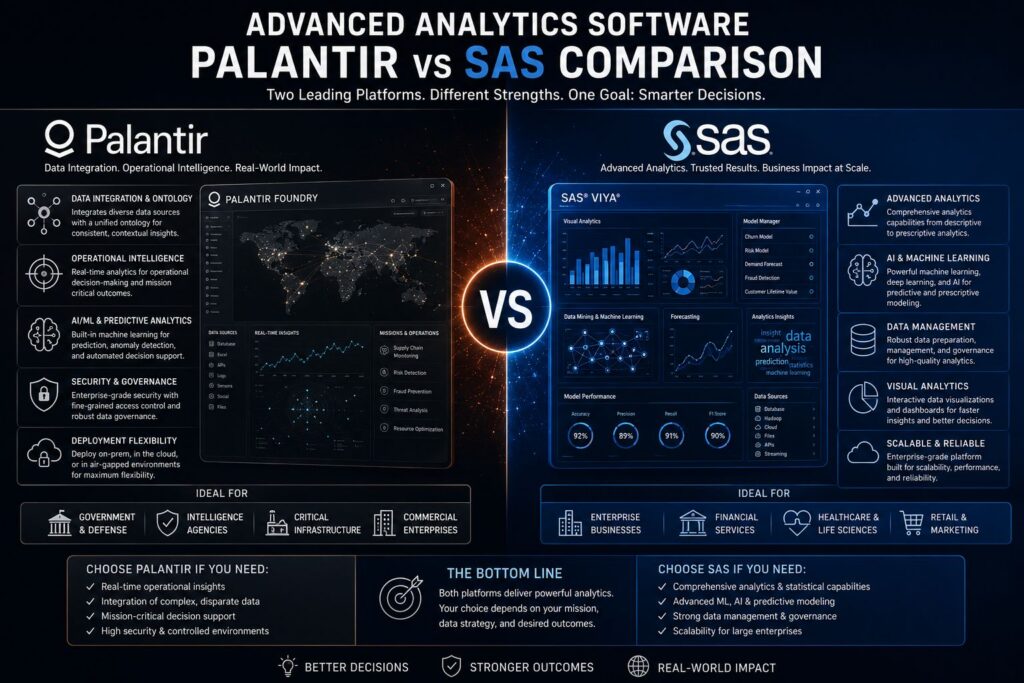
Summary
- Both Palantir and SAS have a 4.6-star rating in the Data Integration Tools market, but they are designed for different purposes.
- Palantir is a leader in operational intelligence and large-scale enterprise data fusion, while SAS is the gold standard for deep statistical modeling and research-driven analytics.
- Palantir has a 1.62% market share in Big Data Analytics with 1,604 customers, while SAS In-Memory Statistics has a 0.00% share with only 3 customers in that category.
- The best platform for your business depends on your industry, data complexity, and whether you need real-time operational insights or rigorous statistical analysis.
- There is a surprising case where using both platforms together makes sense — we will discuss this further in the comparison.
Choosing the wrong analytics platform can cost your business months of wasted implementation time and serious budget overruns — making this decision correctly is crucial.
Palantir and SAS are both titans in the field of analytics, though they each tackle data challenges in unique ways. Palantir was designed to manage huge, intricate datasets in real time. SAS, on the other hand, has spent years honing its statistical accuracy and predictive modeling in fields such as healthcare, finance, and academia. It’s not that one is inherently superior to the other — but one is likely a better fit for your specific needs.
This comparison will give you a clear idea of how each platform performs in important categories, so you can make a confident and informed decision for your organization.
Palantir vs SAS: Which is the Better Analytics Software?
Well, it’s not that simple. It really depends on what you’re looking for. If you want scale, real-time data integration, and operational deployment, Palantir is your best bet. But if you’re looking for statistical depth, established industry trust, and analytical precision, you’ll want to go with SAS. The first step is to understand the main strengths of each platform.
Both Platforms Have a 4.6 Star Rating, But They Cater to Different Needs
Both Palantir and SAS, in the Data Integration Tools market tracked by Gartner, have a 4.6-star rating. Palantir received its rating from 65 reviews, while SAS got its rating from 104 reviews. The same star rating can be misleading at first. Users who love Palantir usually praise its ability to unify separate datasets and quickly produce actionable intelligence. Users who rate SAS highly usually do so because of its reliability in producing defensible, reproducible statistical results. Same score, but for very different reasons.
Palantir has a greater market reach with 1,604 customers compared to SAS’s niche market
In the Big Data Analytics segment, Palantir outdoes SAS In-Memory Statistics in terms of customer reach. Palantir currently has 1,604 customers in this category, making it 12th in the Market Share Ranking Index. SAS In-Memory Statistics, on the other hand, has only 3 customers in the same category, putting it in 47th place. This difference reflects the different paths the two platforms have taken. Palantir has aggressively expanded into the commercial enterprise market, while SAS In-Memory Statistics remains a specialized tool in the larger SAS ecosystem.
Understanding Palantir’s Functionality
Palantir Technologies creates software platforms that are engineered to combine, administer, and scrutinize data on a scale that most companies have never seen. Its two main business products are Palantir Foundry, which is targeted at corporate data operations, and Palantir Gotham, which was initially created for government intelligence and defense purposes. Foundry is the platform that most businesses deal with today.
Designed for Real-Time Data Fusion and Operational Intelligence
Palantir Foundry is designed to pull data from a variety of disconnected sources — databases, APIs, IoT sensors, third-party feeds — and combine them into a single, clear operational image. It doesn’t just store or visualize data. It enables teams to build data pipelines, run models, and implement decisions back into operational workflows without having to move data into different tools. This closed-loop capability is what distinguishes Palantir from traditional business intelligence platforms.
The system employs an ontology-based data model, which enables it to map real-world objects and their relationships directly into the software. For instance, a hospital using Foundry won’t just see rows of patient records – it will see interconnected objects like patients, medications, doctors, and outcomes, all linked and searchable in context. For more insights on how technology is transforming healthcare, explore the latest biometric verification tools being used in the industry.
Palantir’s Strengths: Defense, Intelligence, and Large-Scale Enterprise
Palantir was born out of U.S. intelligence and defense contracting, and this background has shaped the platform’s design. It was created to manage sensitive, mission-critical data on a large scale — such as national security threat analysis, military logistics, and counterterrorism operations. In the commercial enterprise world, this translates into significant strength in sectors like energy, manufacturing, financial services, and supply chain management where operational complexity is high and data is scattered across legacy systems.
Palantir Holds 1.62% of the Big Data Analytics Market Share
According to 6sense data, Palantir has a 1.62% market share in the Big Data Analytics category. Although this may seem like a small number, it’s actually quite significant when you consider the hundreds of competing platforms in the market. Currently, Palantir is ranked 12th and has 1,604 active customers in 10 countries. The company has a strong presence in the United States, United Kingdom, and France. In a recent month, Palantir gained 18 new customers and lost 12, showing that there is a lot of movement in the market.
The Role of SAS in the Market
Since 1976, SAS (Statistical Analysis System) has been a fundamental part of business analytics. As one of the most established analytics platforms available, it is relied on by companies that require statistically accurate, audit-ready results. Although SAS provides a wide range of products, its primary function is as a statistical computing environment with extensive data management, predictive modeling, and business intelligence capabilities.
A Statistical Powerhouse
While Palantir is designed for data integration and operational deployment, SAS is designed for analytical depth. Its programming language, also named SAS, allows analysts to have detailed control over data manipulation and statistical procedures. From regression modeling and survival analysis to time-series forecasting and experimental design, SAS offers a comprehensive range of classical and contemporary statistical methods.
SAS has a strong presence in regulated industries. It is the go-to software in pharmaceutical clinical trials, where it is used to produce statistical analyses that can be submitted to the FDA. Banks use SAS for risk modeling and regulatory reporting. Healthcare payers use it for claims analytics and fraud detection. The platform has gained credibility in these environments due to decades of validated, reproducible results.
Feature Palantir Foundry SAS Analytics Primary Strength Operational data integration & real-time intelligence Statistical modeling & analytical precision Star Rating (Gartner) 4.6 (65 reviews) 4.6 (104 reviews) Big Data Analytics Customers 1,604 3 Market Share (Big Data Analytics) 1.62% 0.00% Market Ranking 12th 47th Core Industries Defense, Energy, Supply Chain, Finance Pharma, Healthcare, Finance, Academia Data Model Approach Ontology-based Procedural / SAS language-based Strongest Geographies US, UK, France Malaysia, US, France
This side-by-side view makes the fundamental difference clear. Palantir and SAS aren’t really competing for the same buyer in most cases — they’re solving different problems at different stages of the data value chain.
SAS Dominates in Finance, Healthcare, and Academic Research
SAS has established a nearly unassailable stronghold in three specific industries. Major banks in the financial services industry depend on SAS for credit risk scoring, detection of money laundering, and Basel III/IV regulatory compliance reporting. Healthcare payers and providers use SAS for population health management, clinical outcomes analysis, and cost modeling. SAS is still the go-to statistical environment for large-scale longitudinal studies and survey data analysis in academic and government research. These aren’t just casual use cases — they’re mission-critical workflows where the price of an analytical mistake can result in regulatory penalties, patient outcomes, or flawed policy decisions.
Direct Comparison of Features
When you compare the two platforms, it becomes clear that the most important features for a Palantir customer may not matter to a SAS customer, and the other way around. However, there are several areas where it makes sense to directly compare the two, especially for companies trying to decide which platform should be the foundation of their data strategy.
Capabilities in Data Integration
Palantir Foundry was specifically designed to handle data integration on a large scale. It can connect to practically any data source – structured databases, unstructured document repositories, streaming data feeds, cloud storage systems, and even legacy on-premise infrastructure. Its Pipeline Builder tool gives data engineers the ability to create, schedule, and monitor complex ETL workflows through a visual interface, eliminating the need for extensive custom coding. An ontology layer then overlays those integrated datasets, creating a semantically rich, queryable representation of the business. For more insights on big data processing platforms, consider reading this comparison of Snowflake and Databricks.
SAS manages data integration through tools such as SAS Data Integration Studio and SAS/ACCESS, which offer strong connectors to major databases and enterprise systems. However, SAS was created in a time of structured, batch-processed data, and its integration architecture is a reflection of that legacy. It is highly proficient for traditional data warehousing environments but does not compare to Palantir’s flexibility when it comes to real-time streaming data or highly heterogeneous source systems. For organizations that operate in modern cloud-native environments, Palantir’s integration layer is simply more nimble.
Advanced Analytics and Machine Learning Tools
Here’s where the rubber meets the road. SAS offers SAS Viya, a state-of-the-art analytics platform that is enabled for cloud use. It includes a full machine learning workbench, AutoML capabilities, natural language processing, and computer vision tools. SAS Viya supports Python and R integration, so data scientists aren’t stuck with the SAS language. The statistical depth available in SAS — particularly for survival analysis, mixed models, and Bayesian methods — is unparalleled by almost any other commercial platform.
Palantir’s approach to machine learning is unique. Instead of providing a set of independent statistical procedures, Palantir AIP (Artificial Intelligence Platform) is built to incorporate large language models and machine learning results directly into operational processes. An analyst doesn’t just operate a model in Palantir — they implement it so that its results actively influence decisions within the platform. For companies that require AI to prompt real-world activities rather than just generate reports, Palantir’s method is structurally superior. Learn more about AI insights for companies.
Usability and User Experience
Historically, SAS is known for its challenging learning curve, especially when it comes to its proprietary programming language. Even though SAS Viya has significantly improved the user experience with its drag-and-drop interfaces and low-code options, many advanced SAS workflows still require a good knowledge of SAS Base programming. This makes the platform difficult to fully utilize for organizations without dedicated SAS developers. On the other hand, Palantir Foundry’s interface is more visually appealing and workflow-oriented, but creating and maintaining ontologies and complex data pipelines still require skilled data engineers. Both platforms are not plug-and-play for non-technical users.
Designed for Large-Scale Operations
Unlike traditional analytics tools, Palantir was built from the ground up to manage large amounts of data. Its structure allows for distributed computing in both cloud and on-site environments. It has even processed petabyte-scale datasets for government and defense clients. Scalability was a key focus during its design, rather than a later addition.
- Palantir Foundry scales horizontally across cloud infrastructure, supporting AWS, Azure, and GCP deployments natively.
- SAS Viya also supports cloud deployment and in-memory processing for large datasets, but enterprise scaling often requires significant infrastructure investment and SAS licensing costs that compound quickly.
- SAS Grid Computing allows workload distribution across multiple servers, but configuration complexity is higher compared to Palantir’s managed environment.
- Palantir’s AIP layer adds operational AI deployment at scale, a capability SAS is still developing within its Viya ecosystem.
For organizations projecting rapid data growth — particularly in IoT, real-time transaction monitoring, or sensor-heavy industries — Palantir’s scalability architecture gives it a meaningful advantage. SAS remains fully capable for large enterprise analytics workloads, but the path to scale requires more deliberate infrastructure planning.
When SAS Viya is deployed on modern cloud infrastructure with the correct configuration, the scalability gap reduces significantly. Organizations that are already using SAS environments should not feel the need to switch to Palantir just for scaling. However, greenfield deployments that are dealing with exponential data growth should seriously consider Palantir’s architecture.
Who Actually Uses These Platforms
Customer profile data tells a revealing story about where each platform has found genuine product-market fit. Palantir’s 1,604 active customers in the Big Data Analytics segment span defense contractors, energy companies, global financial institutions, healthcare systems, and manufacturing enterprises. These are organizations where data complexity is high, operational stakes are significant, and the cost of poor decisions is measured in billions.
Most SAS clients, especially those who use SAS In-Memory Statistics, are highly specialized analytical environments. The SAS ecosystem is enormous — but SAS In-Memory Statistics only has 3 active customers in the specific Big Data Analytics category tracked by market intelligence platforms. This doesn’t mean that SAS’s overall market presence is diminished, but it does show that SAS’s strength is in its broader analytics suite rather than in big data infrastructure specifically.
Palantir’s customer movement data — 18 new customers gained versus 12 lost in a single month — indicates that it is in a competitive market position. The fact that it has a net positive customer acquisition at this scale in enterprise software suggests that Palantir’s commercial expansion strategy is working, despite competition from platforms such as Databricks, Microsoft Azure Synapse, and Talend.
Customer Metric Palantir SAS In-Memory Statistics Total Customers (Big Data Analytics) 1,604 3 Market Ranking 12th 47th New Customers (Recent Month) 18 No data available Lost Customers (Recent Month) 12 No data available Top Customer Countries US, UK, France Malaysia, US, France
Palantir’s Major Markets: US, UK, and France
Palantir’s focus on the United States is a result of its origins in U.S. government and defense contracting, which gave the company both the technical infrastructure and initial revenue it needed to expand commercially. The company’s significant presence in the United Kingdom can be traced back to its extensive contracts with the NHS (National Health Service) and partnerships with financial services in London. France is a key European commercial market where Palantir has invested in local partnerships and government relationships. This geographical focus is a result of a conscious strategy to establish a foothold in English-speaking defense markets before expanding into continental Europe.
SAS In-Memory Statistics Has a Smaller Customer Base
SAS In-Memory Statistics has its largest customer base in Malaysia, which suggests that this particular SAS product has been more successful in that region than it has been globally. While the larger SAS company operates in over 140 countries, SAS In-Memory Statistics has not been as widely adopted by businesses as Palantir Foundry has.
It’s important to remember that SAS’s total customer pool for all of its products is significantly larger than what these big data analytics numbers imply. Companies that use SAS Enterprise Guide, SAS Visual Analytics, or SAS Viya for regular statistical analysis aren’t included in the same market segment data. The three-customer figure for SAS In-Memory Statistics represents a specific product category, not SAS as a whole.
It’s important to understand this difference when making purchasing decisions. If your organization is evaluating the entire SAS platform — including SAS Viya, SAS Studio, and the complete suite of analytics — you’re looking at a much more robust and broadly adopted ecosystem than the in-memory statistics product data alone would suggest. The comparison to Palantir becomes more competitive when SAS Viya is the product under consideration, rather than SAS In-Memory Statistics specifically.
- SAS Viya is SAS’s modern, cloud-enabled flagship platform and the most direct competitor to Palantir Foundry in enterprise analytics.
- SAS In-Memory Statistics is a specialized component, not representative of SAS’s full capability or customer base.
- Palantir Foundry is a unified platform, making direct product-to-product comparisons with specific SAS modules inherently uneven.
- For a true apples-to-apples comparison, organizations should evaluate Palantir Foundry against SAS Viya — not against individual SAS statistical modules.
Palantir vs SAS: Which One Should You Choose?
The decision between Palantir and SAS isn’t about which platform is technically superior — it’s about which one aligns with how your organization actually uses data. Your industry, your team’s technical skill set, your data architecture, and your primary analytics objective should drive the decision more than any feature checklist.
Opt for Palantir if You Need to Manage Operational Data on a Large Scale
Palantir Foundry is the way to go if your company needs to consolidate disorganized, siloed data that comes in large volumes and apply that intelligence into operational workflows almost instantly. If your data engineers are spending more of their time creating and maintaining custom pipelines than they are on providing insights, Foundry’s unified data architecture is the solution to that issue. Companies in the energy, defense, manufacturing, and supply chain logistics industries will find Palantir’s ontology-based approach especially useful.
Palantir is also a good choice if your company is committed to incorporating AI into daily operations instead of keeping it in a research silo. Palantir AIP allows large language models and machine learning outputs to directly impact operational decisions within the platform — a feature that far surpasses what most traditional analytics platforms currently provide.
- Your data is fragmented across multiple legacy systems and needs unified, real-time access
- You operate in a high-complexity environment like defense, energy, logistics, or financial services
- You need to deploy AI outputs into operational workflows, not just generate reports
- Your data volumes are at petabyte scale or projected to reach that level
- You have skilled data engineers on staff who can build and maintain ontologies and pipelines
Palantir’s pricing and implementation complexity make it a serious commitment. Organizations should go in with a clear use case and dedicated technical resources. It is not a plug-and-play solution, and the investment pays off most clearly at enterprise scale where data complexity is genuinely high.
Go for SAS If You Need In-depth Statistical Modelling
SAS, especially SAS Viya, is the best fit if your job requires statistically sound, reproducible, and audit-ready analytical results. If your team consists of trained statisticians, quantitative analysts, or researchers who need to use advanced procedures — from mixed models and survival analysis to Bayesian inference and experimental design — SAS offers an unrivaled depth of validated statistical methodology. Pharmaceutical companies, banks, healthcare payers, and government research agencies have relied on SAS for years because it provides results that can stand up to regulatory examination. If your analytics environment is more about comprehending data than operationalizing it, SAS is the better foundation.
Commonly Asked Questions
These are the questions that businesses often ask when they compare these two platforms. For instance, understanding the impact of big data processing platforms can be crucial for making an informed decision.
Question Quick Answer Which platform has better reviews? Both rated 4.6 stars on Gartner — tied Which has more enterprise customers? Palantir with 1,604 vs SAS In-Memory Statistics with 3 Which is better for statistical analysis? SAS, by a significant margin Which is better for real-time data operations? Palantir Foundry Which is better for regulated industries? SAS for compliance-driven analytics; Palantir for operational scale Can they be used together? Yes — they complement each other well in complex data stacks
The most important thing to understand going into this comparison is that Palantir and SAS are not true head-to-head competitors in the traditional sense. They were built with different missions, for different buyers, solving different problems. The questions below reflect the nuances that matter most when making this call for your organization. For a similar comparison, you can explore the Snowflake and Databricks comparison to understand how different platforms cater to specific needs.
Now that we’ve set the stage, let’s get straight to the answers you’re looking for.
Does Palantir Outperform SAS in Enterprise Analytics?
When it comes to integrating large, complex datasets from multiple sources and implementing data-driven decisions into operational systems, Palantir outperforms SAS in enterprise analytics. Its 1,604 enterprise customers in the Big Data Analytics segment, compared to the 3 of SAS In-Memory Statistics, show where the market is leaning towards for large-scale operational intelligence. Palantir’s architecture, which is based on real-time data fusion and ontology-based modeling, provides a structural edge for enterprises dealing with operational complexity at scale.
On the other hand, SAS Viya is a better choice for businesses whose analytics work focuses on statistical research, predictive modeling, and regulatory compliance. The two platforms cater to different interpretations of “enterprise analytics” — Palantir is great for operational intelligence, SAS is great for analytical depth. The best platform is the one that aligns with what your enterprise analytics team is really trying to achieve.
Which Industries Frequently Use Palantir and SAS?
Palantir has a strong presence in the defense and intelligence, energy and utilities, financial services, healthcare operations, and manufacturing and supply chain industries. These are environments where the data is operationally complex and fragmented across systems, and where the speed of insight can provide a competitive edge or be mission-critical.
SAS is the go-to platform for industries such as pharmaceutical and life sciences, banking and financial risk management, healthcare payer analytics, government and public sector research, and academic and scientific research institutions. SAS is particularly prevalent in pharmaceutical clinical trials, where it is so integral that it’s become the industry standard for creating regulatory submission-ready statistical outputs. This level of institutional adoption doesn’t occur unless the platform has truly gained the trust of its users over many years.
How do Palantir and SAS Stack Up in Terms of Market Share?
When it comes to the Big Data Analytics category, Palantir has a 1.62% market share and is ranked 12th worldwide, with 1,604 customers in 10 countries. SAS In-Memory Statistics, on the other hand, has virtually 0.00% market share in the same category, with 3 customers, and is ranked 47th. It’s worth noting that these figures are for one specific product segment. As a larger company, SAS has a much larger global footprint across its entire analytics product suite, serving customers in over 140 countries. The difference in market share in big data analytics specifically reflects choices about product positioning rather than SAS’s overall size in the market.
Are Palantir and SAS a Good Fit for Small Businesses?
Truth be told, neither Palantir nor SAS is a great fit for small businesses. Palantir Foundry is an enterprise platform with implementation requirements, licensing costs, and technical infrastructure demands that are designed for large organizations. SAS carries hefty licensing costs as well and requires trained analytical staff to deliver value. Small businesses with simple analytics needs are better off with tools like Tableau, Power BI, or Google Looker Studio. Both Palantir and SAS deliver the most value when the complexity of the data problem justifies the investment in the platform.
Is it possible to use Palantir and SAS together in the same data stack?
Yes, it is possible. In fact, for some large enterprises, it is a wise architectural choice to use both platforms together. The main thing to understand is that Palantir and SAS work at different levels of the data value chain. Palantir is great at ingesting, integrating, and operationalizing data across complex enterprise environments. SAS, on the other hand, is great at applying rigorous statistical and predictive modeling to well-prepared analytical datasets. These two capabilities complement each other, rather than being redundant.
Imagine a big bank that uses Palantir Foundry to bring together real-time transaction data, customer behavior data, and market feeds into one operational data environment. Then, it exports curated, analysis-ready datasets from Foundry into SAS Viya for regulatory risk modeling, stress testing, and statistical reporting. Each platform is being used for its strengths, and neither is being used to make up for the other’s weaknesses.
Companies contemplating a two-platform strategy should seriously consider data governance, the integration architecture between the two systems, and the total cost of ownership. Operating two enterprise platforms at the same time is a substantial investment, and it only makes sense when the analytical requirements truly cover both operational intelligence and deep statistical modeling.
- Use Palantir Foundry as the data integration and operational intelligence layer — ingesting, cleaning, and unifying data across sources
- Use SAS Viya as the statistical analysis and modeling layer — running validated predictive models, risk analyses, and regulatory-grade outputs on curated data
- Establish clear data handoff protocols between platforms to avoid duplication of effort and governance gaps
- Align team ownership clearly — data engineers typically own Palantir workflows, while statisticians and quantitative analysts typically own SAS environments
- Evaluate total licensing and infrastructure costs across both platforms before committing — the combined investment is substantial and must be justified by clear business outcomes
The bottom line is that Palantir and SAS represent two different philosophies about what analytics software should do. Palantir believes the job isn’t done until data drives operational action. SAS believes the job isn’t done until the analysis is statistically bulletproof. Both philosophies are valid — and both platforms deliver on their respective promises at enterprise scale.
The first thing you should consider isn’t the platforms themselves, but rather what your organization is most trying to accomplish: Do you want to make your data operational, or do you want to understand it in detail? That one question will guide you more quickly than any feature comparison chart. For a deeper understanding, you might explore a big data processing platforms comparison to see how different solutions can meet your needs.
Companies looking to enhance their analytics approach — whether it’s through improved data integration, more intelligent modeling, or a combination of both — can turn to the team at Eckerson Group. This independent advisory services and research group helps businesses make platform decisions with assurance.
Palantir and SAS are two of the most well-known companies in the field of advanced analytics software. Both offer powerful tools for data analysis, but they cater to different types of users and industries. Palantir is often associated with government and defense sectors, while SAS has a strong presence in the corporate world. For those interested in a detailed comparison of big data processing platforms, Snowflake and Databricks are also worth exploring as alternatives.